At the Burning Bush
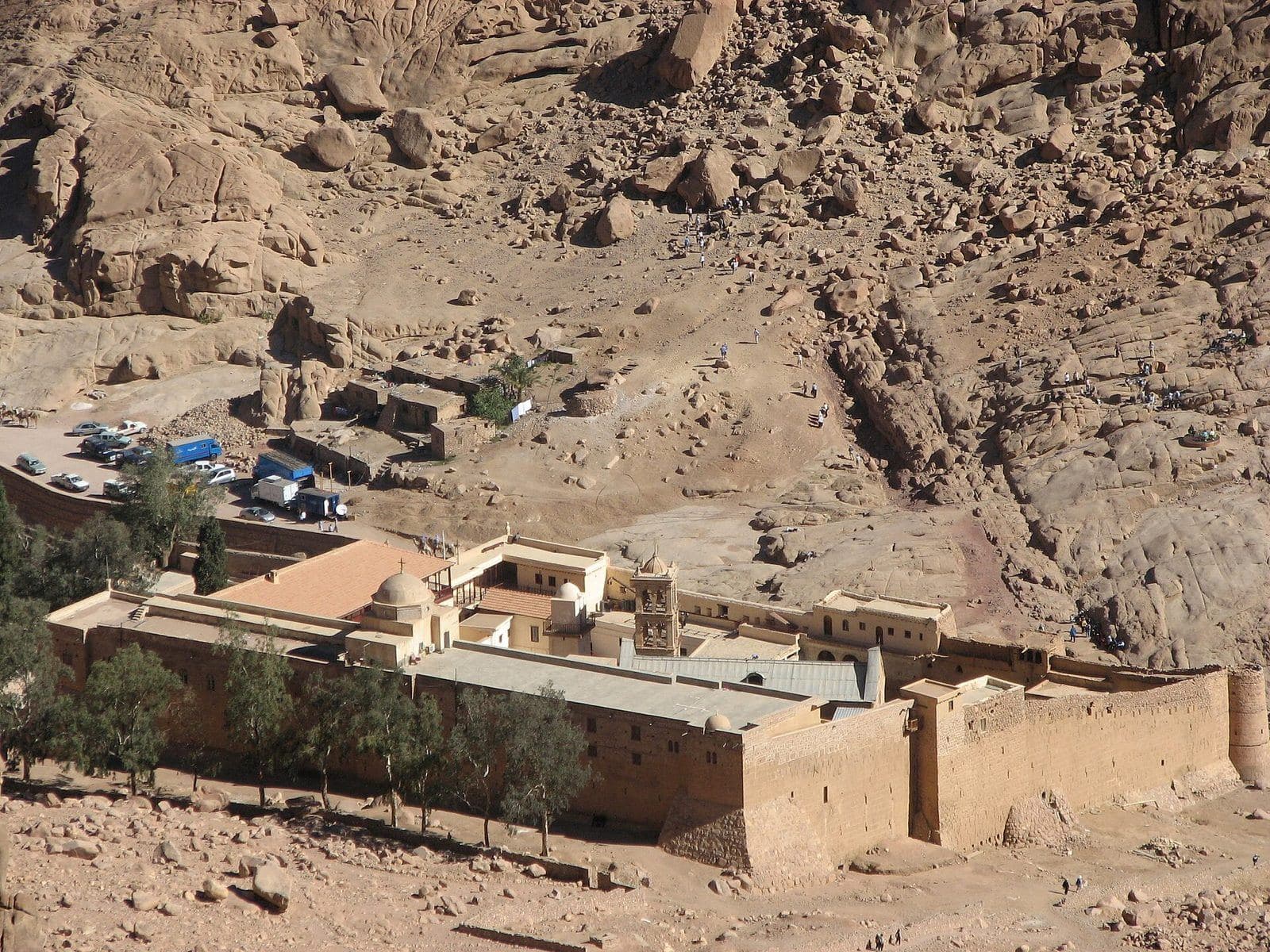
Hermits lived at the foot of Mount Sinai from early Christian times, drawn by the tradition that this was where Moses saw the Burning Bush. In the 4th century, Empress Helena is said to have ordered a chapel built here. Between 548 and 565, Emperor Justinian surrounded it with massive granite walls to protect the monks — walls that still stand.
Catherine of Alexandria
The monastery was later named after St Catherine of Alexandria, a martyr whose remains, according to tradition, were carried by angels to the nearby mountain that bears her name. The monastery has been continuously inhabited by Greek Orthodox monks for about 1,500 years.
Treasures of the library
Its library is one of the oldest continuously used libraries in the world, with thousands of manuscripts in Greek, Arabic, Syriac and other languages. The Codex Sinaiticus, one of the oldest complete manuscripts of the New Testament, was largely kept here until the 19th century. The monastery also holds some of the earliest surviving Christian icons. Within its walls stands a small mosque, built in the Fatimid period.
Icons older than iconoclasm
The monastery holds one of the world's greatest collections of icons, including some of the very few to survive from before the 8th century, when icons were destroyed across much of the Byzantine Empire. Its 6th-century Christ Pantocrator, painted in hot wax, is among the oldest known images of Christ as ruler of the world. The apse of the basilica keeps a 6th-century mosaic of the Transfiguration.
Protected by many rulers
According to the monks' tradition, the Prophet Muhammad granted the monastery a charter of protection, the Achtiname; the monastery holds a copy of it. Over the centuries it was also protected by Fatimid, Mamluk and Ottoman rulers, and the small Fatimid-era mosque inside the walls was built for the monastery's Muslim guards and the Bedouin who served it.
Visiting tips
- Opening hours are short and it closes on some days and religious holidays — check before you go.
- Visit after climbing Mount Sinai at sunrise; the monastery is at the bottom of the trail.
- Dress modestly: shoulders and knees covered.
- Check opening days in advance — the monastery closes on Fridays, Sundays and religious holidays.