The mountain of Moses
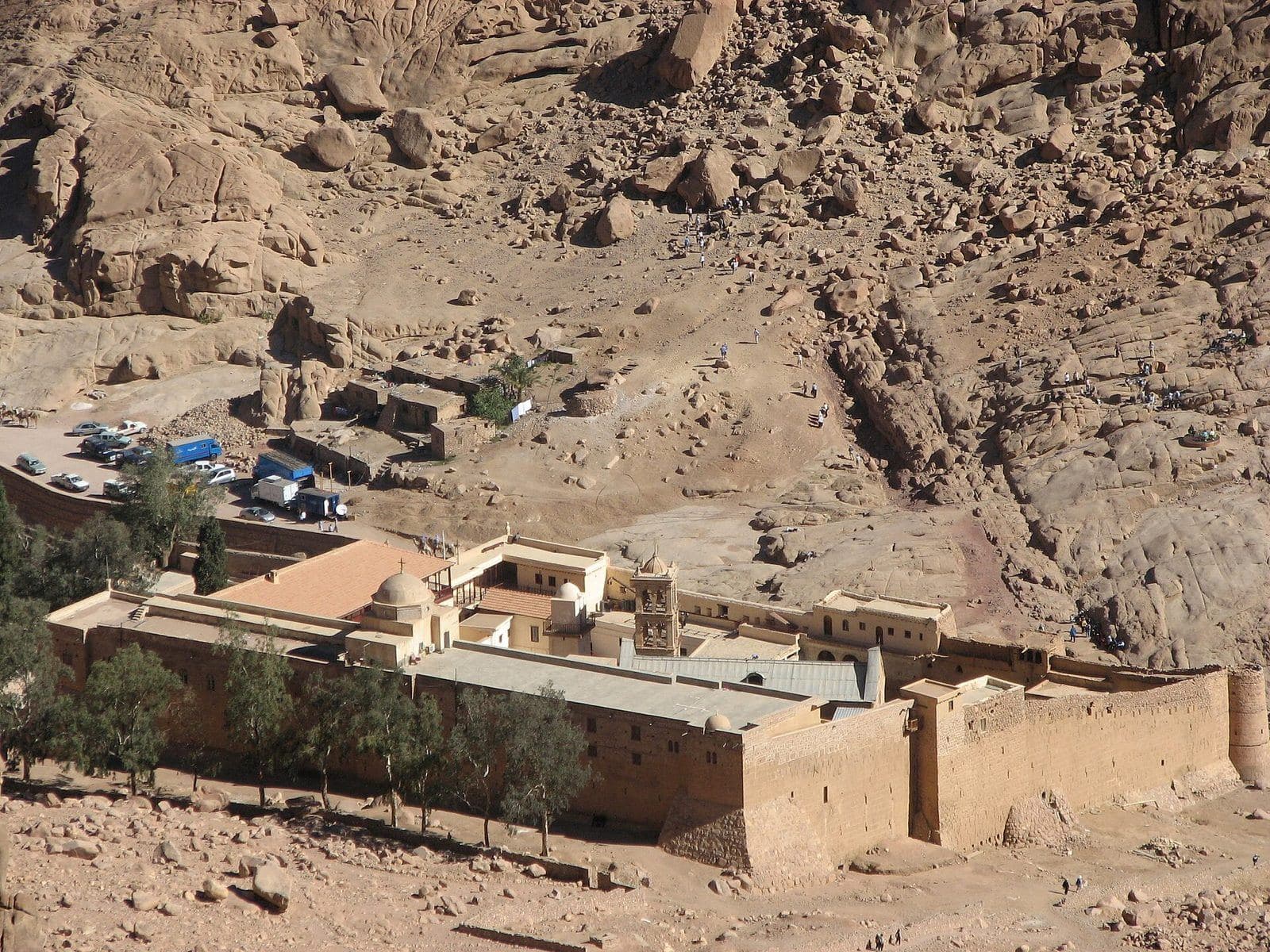
Jewish, Christian and Muslim traditions all honour Mount Sinai as the place where God gave Moses the Law. Scholars debate which mountain the Bible meant, but Jebel Musa ('Mount of Moses') has been identified as Sinai since at least the 4th century, when Christian pilgrims and hermits began to come here.
Two ways up
The Camel Path, built in the 19th century, zig-zags gently up the mountain; camels can carry tired walkers most of the way. The steeper Steps of Repentance — about 3,750 stone steps said to have been laid by a single monk — climb straight up from behind the monastery. Both meet below the summit for the final 750 steps.
On the summit
At the top stand a small Greek Orthodox chapel and a mosque. Most visitors start around 1–2 am to arrive for sunrise, when the granite peaks of South Sinai turn red, pink and gold.
Elijah's Basin
Just below the summit, where the Camel Path and the Steps of Repentance meet, lies a small plateau known as Elijah's Basin, with a lone cypress tree and a chapel dedicated to the prophet Elijah, who, tradition says, sheltered on the mountain. It's the last resting point before the final 750 steps to the top.
The mountains around
Mount Sinai is part of a high granite massif. Mount Catherine next door is Egypt's highest peak, and the valleys between shelter Bedouin orchards and gardens irrigated by mountain springs. Several-day walking routes such as the Sinai Trail, created by Bedouin tribes, lead through them with local guides and camels.
Visiting tips
- A Bedouin guide is required, and we can arrange one.
- Bring warm layers, a torch and water — it can be freezing at the top, even in spring.
- Take the Camel Path up in the dark and the Steps down in daylight.
- Wear proper shoes with grip — the Steps of Repentance are uneven and steep on the way down.