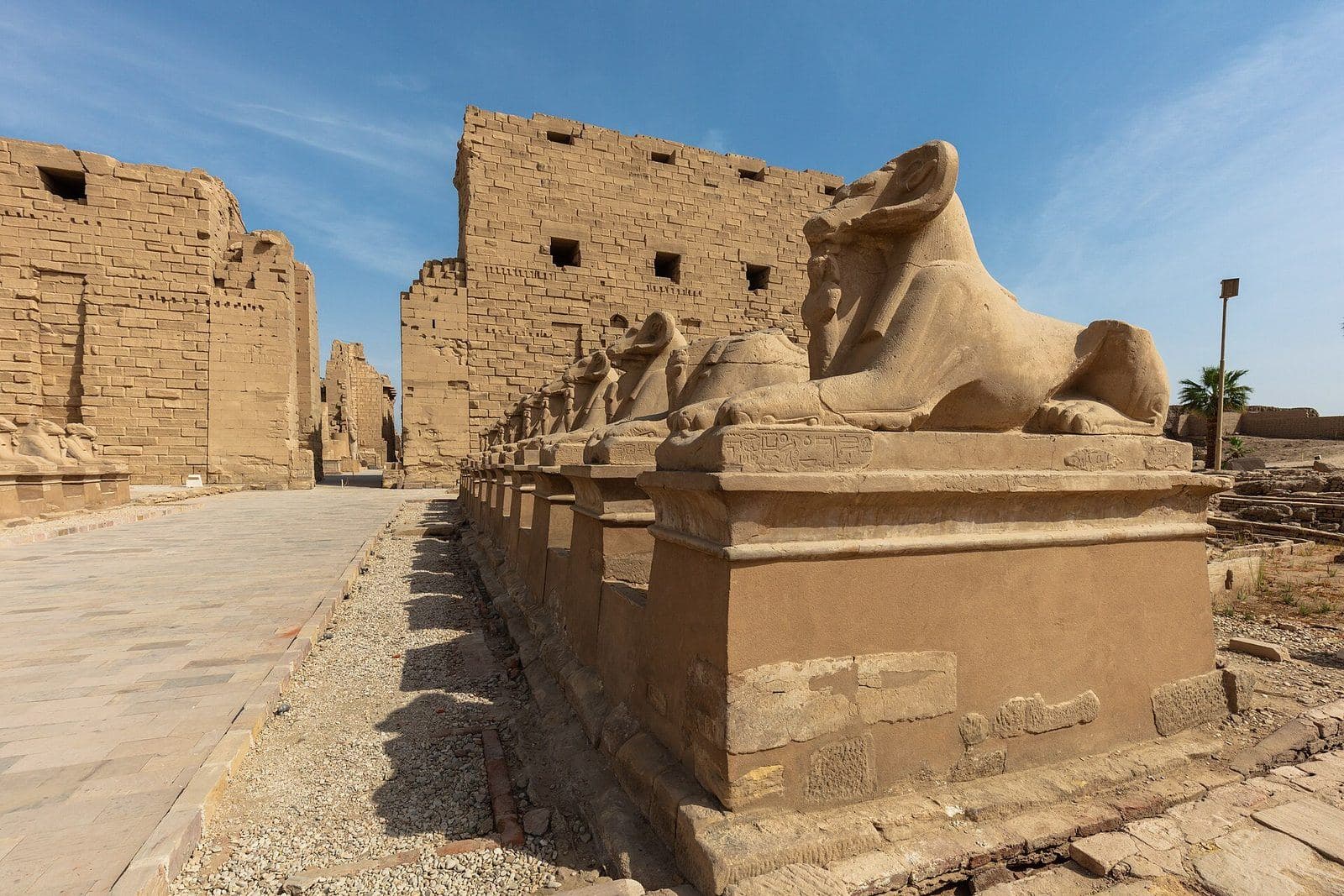
House of Amun
Thebes (modern Luxor) rose to power in the Middle Kingdom, and its local god Amun rose with it. Merged with the sun god Ra, Amun-Ra became king of the gods, and his temple at Karnak became the richest institution in Egypt, owning land, cattle and ships across the country.
Almost every pharaoh of the New Kingdom wanted to leave a mark here, so the temple grew outward in a series of gateways (pylons), courts and halls.
The Great Hypostyle Hall
Begun under Seti I and completed by Ramses II, the hall is a forest of 134 sandstone columns covered in carved and once brightly painted scenes. The 12 central columns are about 21 metres tall; the difference in height allowed light in through stone window grilles. It was designed to evoke the papyrus marsh of creation.
Obelisks and the sacred lake
Hatshepsut raised two granite obelisks at Karnak; one still stands, nearly 30 metres tall. Nearby is the sacred lake, where priests purified themselves, and a giant granite scarab that visitors traditionally walk around for luck.
A city of temples
Karnak is not one temple but several precincts. The Precinct of Amun-Ra alone covers about 25 hectares, and beside it lie the precincts of the goddess Mut and the war god Montu. In the open-air museum inside the complex, archaeologists have rebuilt small shrines that later pharaohs had dismantled and used as filling for their gateways — including the White Chapel of Senusret I, one of the finest Middle Kingdom buildings to survive, and Hatshepsut's Red Chapel.
How the gods travelled
At festivals the statue of Amun left his sanctuary in a gilded boat-shrine carried on the shoulders of priests. The long axis of Karnak — pylon after pylon towards the Nile — was built for these processions, and the smaller 'way stations' along the route were resting places for the god's boat.
Visiting tips
- Go at opening time or late afternoon — the site is huge and exposed.
- The sound and light show at night is a different way to see the halls.
- Allow at least two to three hours, and more with a guide.
- Enter the open-air museum on the left after the first courtyard — many visitors walk past it.